

Quick answer
Simple search: use File Explorer for occasional searches in a Windows folder.
Advanced search: use dedicated search tools like SeekFast for text previews, advanced queries, and frequent searches.
I tested a range of search applications with the same collection of DOC and DOCX files, and will try to present the most practical and reliable methods.
1. Windows File Explorer
Microsoft Word's built-in Find command (Ctrl+F) searches only the document currently open, so I will start with File Explorer, which is the simplest free option on Windows 11. It works best when your Word files are in an indexed folder.
Search a folder
- Open the folder with your files.
- Click the search box in the upper-right corner.
- Type the word or phrase you want to find and press
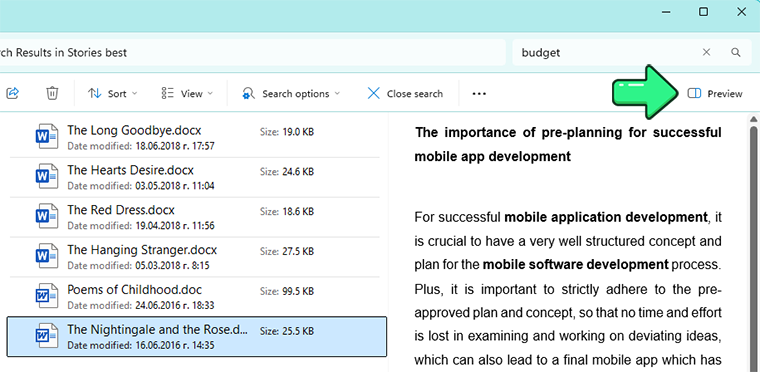
Enter. - Select a result and click Preview in the upper-right corner to view the document without opening Word.
- To jump to the exact match, open the result and press
Ctrl+Fin Word.
File Explorer searches the selected folder and its subfolders. To limit the results to modern Word files, add ext:docx to the query. For older Word files, use ext:doc.
Examples:
annual budget ext:docx— finds Word documents related to both terms."annual budget" ext:docx— looks for the exact phrase.invoice (ext:doc OR ext:docx)— includes both old and new Word formats.
Enable File Contents for a non-indexed folder
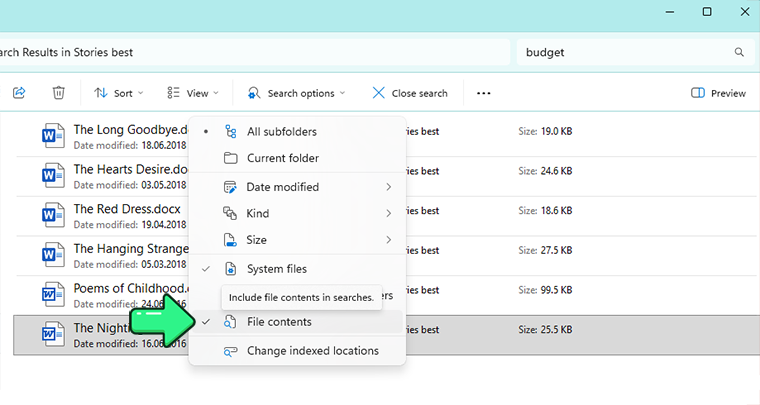
If the folder is not indexed, start a search and select Search options -> File contents. Windows will inspect file contents directly, but a large folder can take much longer to search.
The Preview pane helps you identify the right document without opening every result. It displays the selected Word file, but it does not automatically jump to or highlight the search term.
Add the folder to the Windows index
Indexing means that Windows reads file names, properties, and supported file contents in advance. This makes later searches much faster.
- Go to Settings -> Privacy & security -> Search.
- Under Find my files, choose one of these options:
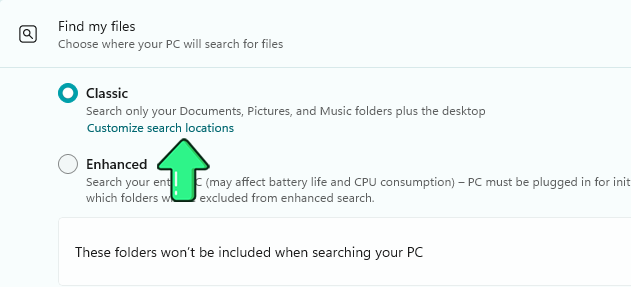
- Classic — indexes common folders such as Documents and Desktop.
- Enhanced — indexes the whole PC but can use more system resources.
- With Classic selected, open Customize search locations -> Modify.
- Select the folder containing your Word files, then click OK.
Microsoft notes that the first index build can take a couple of hours or days. You can keep using the computer while Windows completes it. See Microsoft’s current Windows indexing guide for more details.
For file-name searches, date and size filters, and other Windows methods, see our broader guide to searching files in Windows 11.
Advantages
- Already included with Windows.
- No additional software or account is required.
- The Preview pane can display a selected Word document without opening it.
- Fast in properly indexed folders.
- Supports filters for extension, date, author, and size.
Disadvantages
- The Preview pane shows the document, but it does not automatically jump to or highlight the matching text.
- You may still need to open the file and search again in Word.
- Non-indexed searches can be slow.
- Results depend on the index and the installed document filters.
2. SeekFast
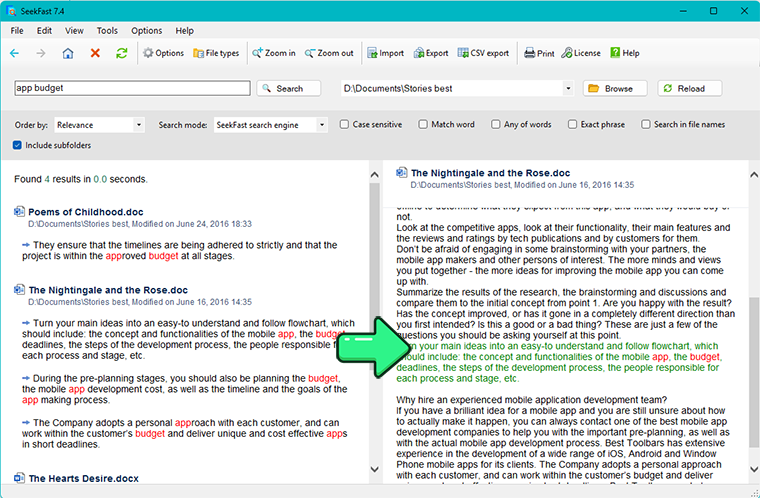
SeekFast works on Windows, macOS, and Linux and supports .doc, .docx, and more than 120 other file formats. It displays the sentence containing the search terms, lets you expand the surrounding text, and ranks results by relevance.
Search Word files with SeekFast
- Download and install SeekFast.
- Open SeekFast and click Browse.
- Select the folder containing the Word documents.
- Wait until the status shows Ready.
- Type a word, phrase, or combination of words and press
Enter. - Click a matching sentence to view more context, or click the file name to open the document.
On Windows, you can also right-click a folder in File Explorer and select Search with SeekFast.
Useful search options
- Exact phrase — finds words together and in the entered order.
- Exact word — avoids partial-word matches.
- Any of words — returns text containing at least one search term.
- Case sensitive — treats uppercase and lowercase as different.
- Search in file names — includes file names as well as document text.
- Include subfolders — searches folders below the selected location.
SeekFast’s own search engine processes the selected folder and gives the best relevance ranking and context preview. On Windows, its Windows Index mode can search very large indexed locations immediately, although the ranking and context are less precise.
Price and limits
The free version has no time limit and searches up to 50 files at once. A Personal License costs $39 as a one-time payment and removes the file limit.
Advantages
- Shows matching sentences and larger text context.
- Ranks the most relevant results first.
- Finds combinations of words even when they are not next to each other.
- Supports Word, PDF, Excel, PowerPoint, email, ebooks, source code, and many other formats.
- Uses the same graphical workflow on Windows, macOS, and Linux.
- Does not run a background index when using its own search engine.
Disadvantages
- The free version is limited to 50 files per search.
- The first scan of a large new folder takes time.
- It does not support regular expressions or complex Boolean query syntax.
3. DocFetcher
DocFetcher is an open-source desktop search program for Windows, macOS, and Linux. It also has a paid version and supports both older .doc files and modern .docx files.
DocFetcher creates an index for the folders you select. Building the first index takes time, but later searches are fast.
Search Word documents with DocFetcher
- Download and install DocFetcher.
- In the Search Scope area, right-click and select Create Index From -> Folder.
- Select the folder containing the Word files.
- Review the indexing options and click Run.
- When indexing finishes, enter a keyword or phrase in the search box.
- Select a result to see a text preview with highlighted matches.
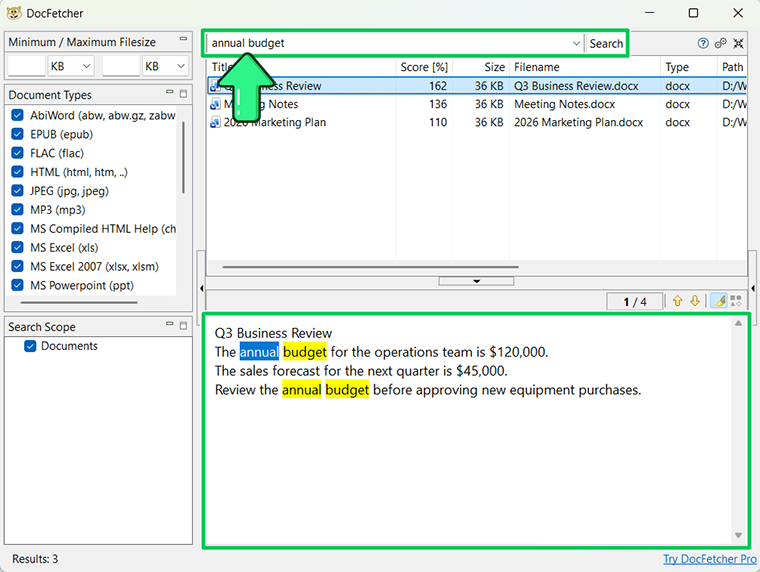
Useful DocFetcher queries
"annual budget"— exact phrase.budget AND forecast— both words must appear.budget OR forecast— either word may appear.budget NOT draft— excludes documents containing draft.budget~— fuzzy search for similar spellings.
Advantages
- Free and open source.
- Works on Windows, macOS, and Linux.
- Supports phrase, Boolean, wildcard, fuzzy, and proximity searches.
- Shows matching text in a preview pane.
- Portable versions are available.
Disadvantages
- You must build an index before searching.
- The interface is less polished than newer commercial tools.
- Search results can be outdated until the index is updated.
4. Other Search Tools
Agent Ransack
Agent Ransack is a Windows search tool with a free Lite mode for personal and commercial use. It can search Office documents, show highlighted matching text, and use Boolean expressions or Perl-compatible regular expressions.
- Open Agent Ransack.
- In Look in, select the folder containing the documents.
- In the file-name field, enter
*.doc;*.docx. - Enter the word or expression in Containing text.
- Make sure Office/PDF document processing is enabled in the advanced options.
- Start the search and select a result to view its matches.
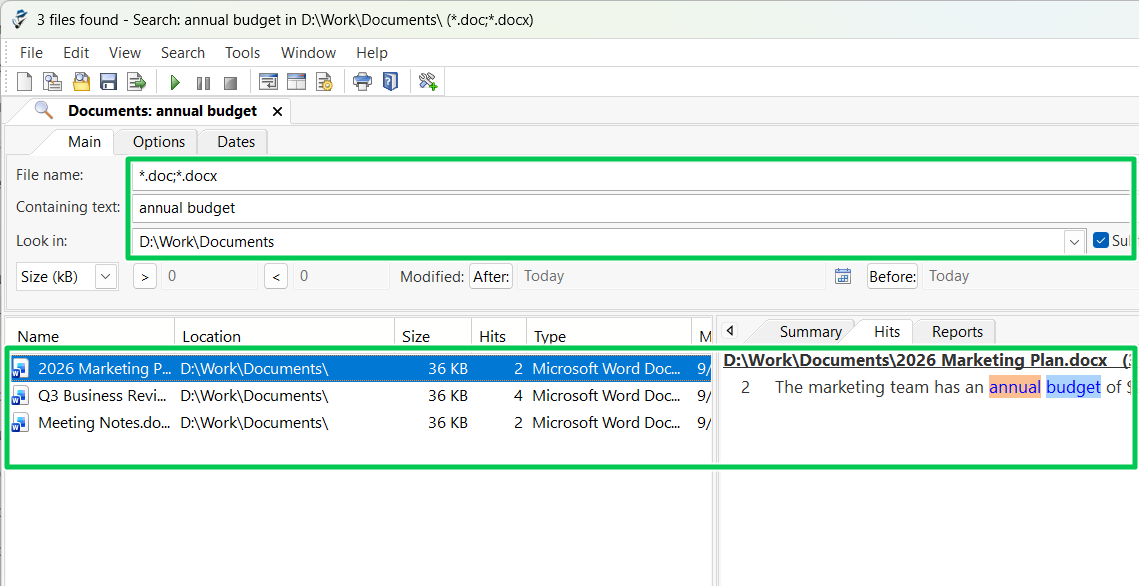
Agent Ransack can search directly without a prebuilt index. Its optional cache makes repeated searches faster. The free interface has many controls, so it can feel technical for a first-time user. A Pro Standard license costs $79.
PowerGREP
PowerGREP is a Windows tool for advanced search, regular expressions, data collection, and bulk processing.
- Select the folder in the File Selector.
- Set the file-format configuration to Proprietary formats or All formats.
- To include only Word files, use the mask recommended in the PowerGREP manual:
*.do[ct];*.do[ct][xm]. - Set Action type to Simple search.
- Set Search type to Literal text for a normal phrase, or choose a regex search type.
- Enter the search text and click Preview.
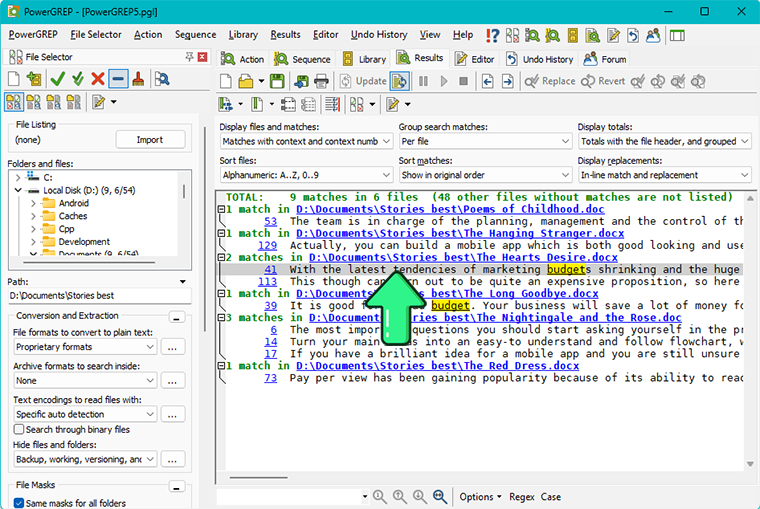
PowerGREP converts Word documents to plain text for searching. It can also search and replace in .docx files, but not in older binary .doc files. A single-user license costs $159. It is a strong option for technical users, but excessive for a simple occasional keyword search.
5. Microsoft 365 and OneDrive
If the documents are stored in OneDrive or SharePoint, you have two options: search them in Microsoft 365 or make them available locally and use File Explorer or another desktop tool.
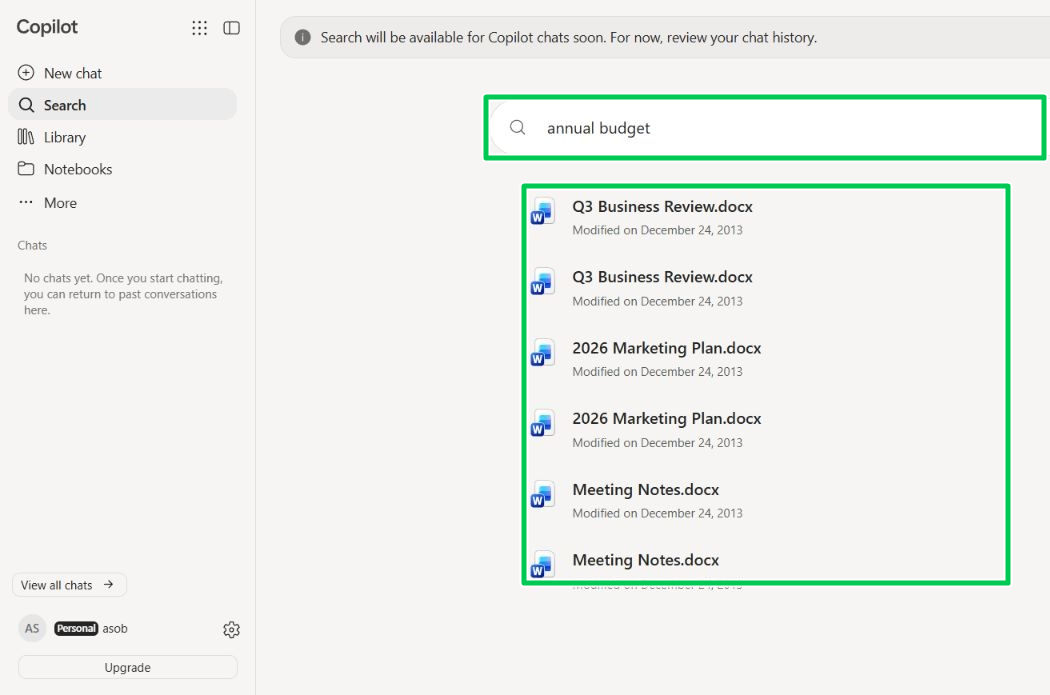
Search in Microsoft 365
- Sign in to Microsoft 365 with the account that has access to the files.
- Use the Search box at the top of the page or app.
- Enter a keyword or put an exact phrase in quotation marks.
- Open the Files results and refine the location or file type if necessary.
Search results are permission-aware: you see only files you are allowed to access. Microsoft Search can search content stored in OneDrive and SharePoint, but the exact filters available can depend on the account and the organization’s configuration. Microsoft provides more detail in its overview of modern search in SharePoint and Microsoft 365.
Search OneDrive files locally
Windows desktop search can find an online-only OneDrive file by name, but it cannot search inside that file because its contents are not stored on the PC.
- Open your OneDrive folder in File Explorer.
- Right-click the folder containing the Word documents.
- Select Always keep on this device.
- Wait until the files show the green availability icon.
- Search the folder with File Explorer, SeekFast, or another desktop tool.
Microsoft explains the difference between online-only and local files in its OneDrive Files On-Demand guide.
6. Search Word Files on Mac
For occasional searches, use Finder or Spotlight. Both can find text in indexed Word documents, but the results depend on Spotlight indexing and usually show limited matching context.
For regular searches across many Word files, use a dedicated tool such as SeekFast or DocFetcher. Both are described above and show more context than Finder or Spotlight.
For step-by-step instructions, search filters, and indexing fixes, see our complete guide to searching document contents on Mac.
7. Search Word Files on Linux
Standard Linux tools are not a convenient way to search inside Word documents. grep and ripgrep search plain text, while .docx files are compressed packages and older .doc files are binary. find and locate can find files by name, but not text inside them.
For the easiest desktop workflow, use SeekFast or DocFetcher. Both can search Word files directly and show matching text without a separate conversion step.
For more search options and troubleshooting, see our complete guide to searching text in multiple files on Linux.
8. AI Assistants
Two general-purpose AI apps can also work with Word files:
- ChatGPT Desktop (Work): when local Work is available for your account, you can open a folder and ask it to find documents by topic, compare them, or summarize them.
- Claude Desktop (Cowork): with a paid plan, you can give it access to a local folder and ask questions about the documents in natural language.
They are useful when you remember the subject rather than the exact words, but they are not replacements for dedicated search software:
- They are not designed to maintain a complete, continuously updated index of every Word file.
- They may inspect only selected files or passages and can miss individual matches.
- Their answers may be incomplete or inaccurate.
Use File Explorer or a dedicated search tool when you need every match, exact phrases, repeatable results, filters, or a clear list of matching passages. AI assistants are better for exploratory questions, summaries, and comparisons.
Both require an account and an internet connection, and relevant file content may be processed in the cloud.
9. Fix Word File Search Problems
Find the problem below that best matches what you see.
Word files from one folder do not appear in search results
Windows may not be indexing that folder. Go to Settings -> Privacy & security -> Search -> Customize search locations -> Modify, then add it.
Windows finds the file name, but not words inside it
Windows is probably indexing file properties but not their contents. Open Indexing Options -> Advanced -> File Types, select doc and docx, then enable Index Properties and File Contents.
Results are incomplete or out of date
The Windows index may be incomplete or damaged:
- Open Indexing Options.
- Click Advanced.
- Under Troubleshooting, click Rebuild.
Rebuilding can take several hours on a computer with many files.
If Windows Search itself will not open or respond, use our separate guide to fixing Windows Search problems.
OneDrive files are found only by name
The files may be online-only, so their contents are not stored on the computer. Right-click the OneDrive folder and select Always keep on this device, then wait for the files to download before searching again.
A password-protected document is missing
Search tools cannot read encrypted content. If you are authorized to do so, open the document in Word, remove the password or protection, save it, and search again.
Visible words inside an image are not found
Word files can contain screenshots or scanned pages. Ordinary text search cannot read words that exist only as pixels. Use optical character recognition (OCR) to convert the image to searchable text.
One Word file never appears in the results
The file may be damaged or use an unsupported format. Open it in Word and save a new copy as .docx. If Word cannot open it correctly, repair the document before searching again.
An exact search returns no results
The query may be too strict. Remove quotation marks, try fewer words, check the spelling, and turn off case-sensitive or whole-word matching.
Conclusion
In this article, I’ve shared the methods that worked best in my tests for searching text across multiple Word documents. But people often have their own favorite tools and workflows. Which method do you use? Have I missed a useful application or approach?
You can share your experience in one of the following ways:
- Leave a comment using the form below.
- Join our discussion on Reddit.
Frequently Asked Questions
Can Microsoft Word search multiple documents at once?
No. Word’s Ctrl+F command searches only the document currently open. For multiple files, use File Explorer on Windows or Finder or Spotlight on Mac. On Linux, a document search app such as DocFetcher or SeekFast can search Word files directly; both also work on Windows and Mac.
How do I search for a word in all Word documents in a folder?
Open the folder in File Explorer, type the word in the search box, and press Enter. If no results appear, enable Search options -> File contents and make sure .doc and .docx are configured for content indexing.
How do I search for an exact phrase in multiple Word documents?
Put the phrase in quotation marks, for example "annual sales forecast". SeekFast also has an Exact phrase option, while DocFetcher, Agent Ransack, and PowerGREP provide additional query controls.
Why does File Explorer find the file name but not text inside the file?
Windows is probably indexing only file properties. Open Indexing Options -> Advanced -> File Types, select doc or docx, and enable Index Properties and File Contents.
Can I search inside online-only OneDrive Word files?
Use Microsoft 365 Search, or right-click the OneDrive folder and select Always keep on this device. Windows desktop search can find online-only files by name, but it cannot inspect their contents until they are downloaded.
What is the best free tool for searching multiple Word documents?
File Explorer is the easiest built-in option on Windows, and Finder or Spotlight are the built-in choices on Mac. DocFetcher is a free cross-platform option, including on Linux, that searches Word files directly and shows matching text in a preview pane.
Can I search DOC and DOCX files together?
Yes. File Explorer and the tools in this guide can search both formats when their file filters include .doc and .docx. Note that older .doc files may require an installed document filter or a tool with its own decoder.
Can these tools search text inside images in a Word document?
Not with ordinary text search. Text inside a screenshot or scanned page must first be converted with optical character recognition (OCR).
Can I replace text in multiple Word documents at once?
That is a separate and riskier task. PowerGREP can search and replace in .docx files, but it cannot replace text in older binary .doc files. Always back up the documents and preview every change before running a bulk replacement.

I have only recently discovered SeekFast. As a manuscript editor in the publishing field, I consider it a godsend. To explain, all of the books I work on are made up of multiple files (chapters, typically). In checking source citations against the bibliography (a major task for any editor), for which I use several macro tools, SeekFast speeds up the process and fills in the gaps of what the other tools cannot address. In checking consistency of spelling and phrases across multiple files, SeekFast is equally a blessing. An immense timesaver. And working efficiently is always imperative in the publishing field. Never mind the convenience of its (SeekFast’s) enabling a quick search across countless publications for a particular (say) source or spelling.
Seek Fast is great software. I use it to search words in word documents,
Many thanks for this very informative and clear article.
How about Anytxt? I am using it.
Hi Smit,
Many applications perform text searches in documents, Anytxt being one of them. Most of these applications perform indexing of your files, which, however, takes time and resources of your computer.
When developing SeekFast, we designed it to avoid indexing so that your computer can be free and, at the same time, you can search fast. Also, SeekFast has many valuable features through which we aim to make the application as helpful as possible for your work.
You can read more about SeekFast features at https://seekfast.org/features
Hi Dimitar
SeekFast looks good but is limited to only 50 files and I need to search 600-ish and as I only do this very rarely it’s not worth the license.
Unfortunately, you don’t say how many file the others can do with their free versions. FYI
Hi Vic,
Thank you for sharing your opinion! If SeekFast is doing a good job for you, I can offer you participation in our partnership program, whereby you will receive a free personal license.
HI,
It seems the program is great but I tried the program and it does not work good with me when I tried it with document that has Arabic text.
Click on the following link to see the image from SeekFast program:
https://1drv.ms/i/s!AkZebsOuKoY7koo3VegKAtKG1UkNvg?e=Eey0bH
and click on the following link to see the image of the content of the document that I tried to search in it by SeekFast:
https://1drv.ms/i/s!AkZebsOuKoY7koo2vUNQx4Ei-b_HMg?e=mlv9dx
I am also having trouble finding the contents of Word files. It is great to see the information you share, it means a lot to me. Many thanks,
Good Morning
I wonder if it would do Hebrew word searches.
Also searching by a single word isn’t appropriate for my needs. Can it do a search of two or three words with a gap of lets say 10 words.
For instance I would look for the two words “pool” and “hot” and as a result I would get: “The pool was very hot” and Yesterday was very hot and the cool pool was godsend” etc
Thanks
Rosh
Hi Rosh,
Yes, of course, SeekFast supports all languages, including Hebrew.
One of the important advantages of the program is that it can search for combinations of words that are not in sequence in the text. You can easily see this for yourself – SeekFast has a free version that you can use for an unlimited time.
Thanks, Dimitar,
The SeekFast app is excellent for finding a string in all MS Word documents within a folder. The SeekFast context menu makes it extremely convenient and easy to use. It also supports the Chinese language, e.g., “測試 3 中文”. 🙂
Hi Alex,
Thank you for your valuable comment! I’m pleased that SeekFast works so well for you for searching Word files! Yes, indeed, the application works with all languages, including Chinese.
Agent Ransack cant even do a basic install to a custom directory on another drive. No thanks.
Hi Keith,
Thanks for sharing this! It sounds like Agent Ransack did not let you install it to a custom folder on another drive, which is definitely frustrating.
I mentioned it in the article as one possible tool for searching text in Word files, but installation flexibility is also important in real-world use. I’ll keep your comment in mind when updating the article.
If you want a tool that supports a simpler setup, you could also try SeekFast.